
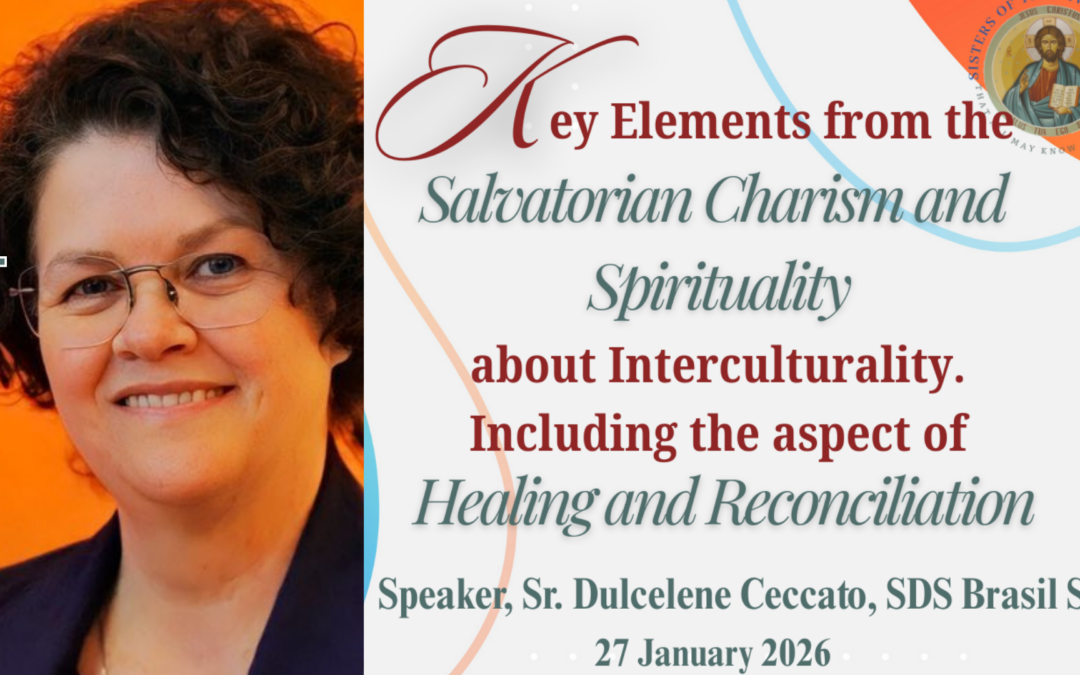
Interculturality as our Salvatorian DNA
“How do we deal with the misunderstandings and prejudices that arise in our common life?” This was the opening inquiry of our recent online formation, a journey that led us from the practicalities of community living to the very roots of our Salvatorian identity. In a world often divided by nationalistic boundaries, we are called to a different way of being: an interculturality rooted in the Gospel and the visionary courage of our Founders.
The Sacred Task of Overcoming Prejudice: The dialogue began with a reflection on the “second column” of our shared experiences—the space where we confront the shadows of aggression, insecurity, and judgment. We recognized that to move toward a genuine “culture of encounter,” we must cultivate a specific set of spiritual attitudes:
- Acceptance and Appreciation: Viewing cultural differences not as obstacles, but as a garden of diversity.
- The Humility of Equality: Remembering we are children of the same God, which allows us to listen without judging and to separate ourselves from the anger of others.
- Inner Freedom: Understanding that gossip and assumptions often spring from insecurity. To overcome them, we seek a “great inner freedom” that allows for deep, transformative dialogue.
If we look back to the 19th century, to the era of the Kulturkampf (Culture Struggle). It was within this period of intense social and ecclesiastical tension that Father Francis Jordan and Mother Mary of the Apostles received the inspiration for our Society. Even though the word “culture” does not appear in Father Jordan’s early writings, his life was a testament to apostolic universality. His gift for languages and his insistence on the “Festival of Languages” in 1889 were prophetic acts. He refused to allow the Salvatorian mission to be narrowed by national interests. In our “Salvatorian DNA,” we carry this mark of inclusion: All peoples, all nations, all races, all tribes.
Our Universal Mandate: Our charism is not a static definition but an “ever-overflowing source of meaning.” Guided by the insights of the late Sister Carol Terstriep, we reaffirmed our identity through four pillars of the Word:
John 17:3: Knowing the one true God through experience and witness.
Mark 16:15: The universal mission to preach to every creature.
Matthew 28:19-20: Involving others and forming disciples across all nations.
Daniel 12:3: Committing ourselves to interior formation and justice.
As apostolic women, our consecration is ultimately a vow of freedom—freedom to serve. To be a “universal sister,” we must continually ask the Lord: “From what limitations or prejudices do I need You to free me?” This is not just a skill, but a prophetic way of life. It is the realization that we are always “Being Salvatorian”—a dynamic, ongoing process of construction.
Let us look to Jesus, the Master of Dialogue. Whether speaking with Nicodemus, the Samaritan woman, or the sick and the poor, Jesus looked beyond appearances to the heart. Our charism is our wisdom. It has been tested by time, suffering, and success. As we move forward, we need to ask ourselves: If we have a charism that transcends all human situations, what could possibly separate us? May we continue to walk this path of “walking barefoot” into the mystery of the other, united by the biblical mandate that makes us one apostolic body.